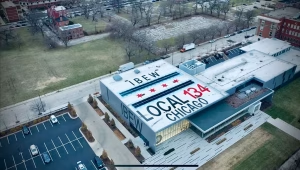
IBEW Local 134 is the Chicago local, and it doesn’t run its apprenticeship the way most locals do. If you’re used to reading about online application windows and a straightforward test-then-interview path, set that aside. Local 134 has its own process, its own training trust, and a few requirements that catch first-time applicants off guard.
This is a walk-through of how to apply, what makes Local 134 different, and the screenings you’ll need to clear before you’re in. One thing up front, and it matters more here than almost anywhere: the details below can change. Dates, fees, and steps get updated, so treat this as your orientation to the process and confirm the current specifics directly with the source before you act. More on who that source is in a moment.
Who Runs the Local 134 Apprenticeship?
The apprenticeship isn’t run by the local hall directly. It’s run through EJATT, the Electrical Joint Apprenticeship and Training Trust, jointly sponsored by IBEW Local 134 and the Electrical Contractors’ Association of Chicago. EJATT handles registration, training, and everything in between for apprenticeships across Cook County.
That’s the name to know. When you’re looking for current requirements or application dates, EJATT is your source of truth, not a third-party site and not a friend who applied a few years back. Their process is specific, and it’s the kind of thing that changes from one registration cycle to the next.
What Makes Local 134 Different
A few things set this local apart from the standard path, and they’re worth knowing before you start so nothing surprises you.
| What’s different | What it means for you |
|---|---|
| You register in person | There’s no online-only application window to wait for. Registration happens in person at the training institute, on a set weekly schedule. You show up with your documents. |
| There’s a registration fee | A non-refundable fee is due at registration, payable by money order. Budget for it, and bring it in the correct form, because they won’t take anything else. |
| The physical screening is real | Local 134’s process includes a physical component that mirrors the demands of actual construction work. This isn’t a formality. It’s meant to test whether you can handle the job. |
| Screenings come after the offer | A drug screen, a physical exam, and a background check are all required once you’re offered a spot. Clearing them is part of getting in, not an afterthought. |
How to Register
Registration for the electrical program happens in person at the IBEW-NECA Technical Institute in Alsip, Illinois, not through an online form. EJATT takes registrations every Wednesday from 9:00 a.m. to 11:00 a.m. at 6201 W. 115th Street, and you report in person with everything you need in hand. Those details come straight from EJATT’s registration information, which is the page to check before you go.
Come prepared with your documents, because you register on the spot. Here’s what the process has required:
| What to bring | Notes |
|---|---|
| Valid driver’s license | Bring the original. |
| Original Social Security card | The original, not a copy. |
| Registration fee | $50, non-refundable. Money order only, made payable to EJATT. |
| Proof of employment eligibility | A copy of your U.S. birth certificate, U.S. passport, Certificate of Citizenship or Naturalization, or Permanent Resident card. |
| Proof of high school graduation | A copy of your HS transcript with a graduation date, your diploma, or a GED certificate. College transcripts don’t satisfy this one. |
| Proof of one year of algebra | A transcript showing one full year of high-school algebra, or a post-high-school algebra or higher course, with a grade of C or better. A GED math certification doesn’t count here. |
A couple of details worth calling out. High school seniors in their final semester can register with acceptance contingent on graduation, so you don’t have to wait until you’ve walked. And the minimum age at registration is 17, a year younger than many people expect.
The Screenings: Physical, Drug, and Background
This is the part Local 134 is known for, and it’s where the local’s process gets more demanding than most.
Orientation starts with intense physical training built to mirror on-site work conditions. The idea is simple: electrical construction is physically hard, and the program wants to know you can do it before it invests years in training you. Applicants are tested against those physical demands as part of the process, not waved through.
On top of that, once you’re offered an apprenticeship, three screenings are required before you’re selected for classroom instruction: a drug screen, a physical exam, and a background check. You’ll also need to show that you can perform the essential functions of an apprentice electrician, with or without a reasonable accommodation.
On the drug screen specifically, one thing worth saying plainly for a Chicago audience: Illinois legalizing recreational cannabis does not change this requirement. The screening still applies, and a positive result can cost you the spot. Don’t let the state law lull you into assuming otherwise.
The reason it holds is that legalizing a substance at the state level doesn’t override workplace safety obligations. Illinois law specifically preserves an employer’s right to enforce a zero-tolerance or drug-free workplace policy, and electrical construction is exactly the kind of safety-sensitive work where those policies stay firmly in place. Cannabis remains off-limits here regardless of what you can legally buy on the way home.
Worth planning for as well: the union screening usually isn’t the only one you’ll face. Many of the jobsites you get dispatched to run their own drug testing when you first report, and some contractors test again after that. Clearing the screening once doesn’t mean you’re done with them.
What Happens at the Local 134 Physical Test
This is the question applicants ask more than any other, and the honest answer is that the specifics depend on who’s running it and when. EJATT doesn’t publish a task-by-task breakdown, and the routine has shifted over the years. What follows is what applicants consistently describe, so treat it as a realistic picture rather than an official checklist.
The physical portion is usually described as a sustained block of calisthenics rather than one max-effort test. Applicants report cycling through push-ups, jumping jacks, sit-ups, leg lifts, and squats with only enough rest between exercises to get into position for the next one, running somewhere around twenty minutes end to end. Conditioning matters more than raw strength here, because the difficulty comes from the lack of recovery rather than from any single movement.
Beyond the calisthenics, applicants have described carrying a bundle of half-inch rigid conduit a few hundred yards through the building, and climbing a three-story scaffold while wearing a harness. Both map directly onto real jobsite work, which is the entire point of the exercise.
Take the preparation seriously. Applicants have reported people who couldn’t finish, and in a few cases needed medical attention, because they showed up expecting a formality. If you can’t currently do continuous calisthenics for twenty minutes, that’s your starting point, and closing that gap takes weeks rather than days. Show up hydrated, eat something light beforehand rather than nothing or too much, and don’t make it harder on yourself the night before.
One more thing worth knowing: applicants who get in report that the conditioning doesn’t stop once you’ve passed. It carries on through the early weeks of school.a
The GAN Aptitude Test
Local 134 uses the GAN aptitude test as part of its selection process rather than the standard IBEW exam most locals administer. If you’ve been preparing off general IBEW aptitude test material, that’s worth catching early, because the two are not the same test.
At a high level, the GAN is a timed, multi-section exam, and it covers more ground than the standard IBEW test. Alongside the math and reading comprehension you’d expect, it adds spatial reasoning, mechanical comprehension, and problem solving. Each section is timed separately and the pacing is tight, so working quickly matters as much as working accurately.
That’s the short version. For the full breakdown of every section, what each one tests, and how to prepare for them, read our GAN aptitude test study guide.
As always, confirm the current test directly with EJATT when you register. Locals do change their process, and EJATT is the only source that’s current.
The One Rule That Matters Most
Every specific in this article, the dates, the fee, the documents, the test, is subject to change, and Local 134 updates its process from cycle to cycle. That’s not a disclaimer to skim past. It’s the single most important thing to take away.
Before you do anything, go to EJATT directly and confirm the current requirements. Check their website, or contact the training institute, and follow their instructions as they stand today. A local’s process is whatever the local says it is right now, and they are the only source that’s never out of date.
Frequently Asked Questions
How do I apply to IBEW Local 134?
You register in person through EJATT, the Electrical Joint Apprenticeship and Training Trust, at the IBEW-NECA Technical Institute in Alsip, Illinois, during its registration window. Bring your driver’s license, Social Security card, the registration fee, and proof of employment eligibility, high school graduation, and one year of algebra. Confirm the current schedule and requirements with EJATT before you go.
What are the requirements for the Local 134 apprenticeship?
You need to prove employment eligibility, high school graduation or a GED, and one full year of high-school algebra (or a higher-level course) with a grade of C or better. The minimum age at registration has been 17. Upon an offer, you must also pass a drug screen, a physical exam, and a background check, and be able to perform the essential functions of an apprentice electrician.
Does Local 134 require a drug test?
Yes. A drug screen is required upon an offer of apprenticeship, along with a physical exam and a background check. Illinois recreational cannabis law does not change this requirement.
Is there a physical test for Local 134?
Yes. Local 134’s process includes a physical component designed to mirror the demands of construction work, and a physical exam is required after an offer. The program wants to confirm you can handle the physical realities of the trade before training begins.
Where is the Local 134 apprenticeship located?
Registration and training run through the IBEW-NECA Technical Institute in Alsip, Illinois, with a Chicago campus at the Westside Technical Institute. The program serves Cook County.
Ready to Apply?
Local 134 is one of the largest IBEW locals in the country, and its apprenticeship is a direct path to a skilled, well-paid trade in Chicago. The process is more hands-on than most, in-person registration, real physical screening, and a full set of checks, but none of it is a mystery once you know what’s coming.
Get your documents in order, confirm the current schedule with EJATT, and show up ready. That’s the whole start.