Standard vs. Optional Load Calculations in the 2026 NEC
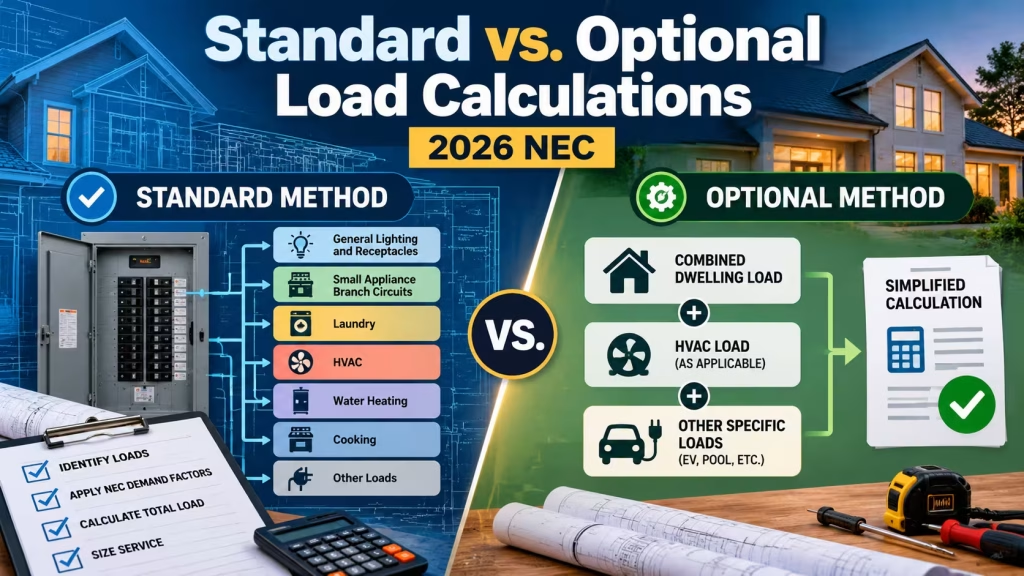
When calculating the feeder or service load for a dwelling, the 2026 NEC provides two main approaches: the standard method and, when the installation qualifies, the optional method in Section 120.82.
The standard method calculates different categories of load separately and applies the NEC rules that belong to each category. The optional method combines many dwelling loads into a larger general-load calculation and applies a broader demand factor.
Both methods account for the fact that every connected load in a dwelling is unlikely to operate at full capacity at the same time. The main difference is how they account for that load diversity.
Quick Comparison
Standard vs. Optional Load Calculations at a Glance
| Standard Method | Optional Method |
|---|---|
| Found primarily in Article 120, Part III | Found in Section 120.82 |
| Treats more load categories separately | Combines many dwelling loads |
| Uses category-specific calculation and demand rules | Uses a broader general-load demand factor |
| General feeder and service calculation method | Only permitted when the requirements of 120.82 are met |
| Can result in a different calculated load | Can result in a different calculated load |
What Is the Standard Load Calculation Method?
The standard method is the general feeder and service load calculation method found in Article 120, Part III of the 2026 NEC.
It is best thought of as a category-by-category calculation.
For a dwelling, the calculation can include loads such as:
- General lighting and receptacles
- Small-appliance and laundry circuits
- Small-appliance and laundry circuits
- Fastened-in-place appliances
- Electric ranges and cooking equipment
- Clothes dryers
- Heating and air-conditioning equipment
- Motors
- Electric vehicle supply equipment, or EVSE
The important part is that these loads are not necessarily treated the same way.
The NEC provides specific calculation rules and demand factors for different types of loads. For example, dwelling lighting loads have their own demand rules, certain groups of fixed appliances may qualify for a demand factor, and ranges, dryers, heating, and air-conditioning equipment each have applicable requirements.
Under the standard method, you apply the appropriate rules to each category and combine the results to determine the calculated feeder or service load.
Preparing For An Electrical Exam? Take Our Free Practice Test
See where you stand before test day.
What Is the Optional Load Calculation Method?
The optional dwelling load calculation is found in Section 120.82 of the 2026 NEC.
Instead of separately applying as many category-specific demand factors, the optional method allows many dwelling loads to be combined into a larger general-load calculation.
Under the 2026 NEC, the general-load portion of the optional calculation uses:
- 100% of the first 8 kVA
- 40% of the remaining general load
Heating and air-conditioning equipment is handled separately under 120.82(C), while EVSE is added separately at 100% under 120.82(D).
In simplified terms, the optional method works like this:
Combine many dwelling loads → apply the optional demand factor → add the applicable HVAC and EVSE loads.
That is the biggest conceptual difference between the two methods. The standard method handles more loads through individual rules, while the optional method consolidates many of them before applying its demand factor.
Why Are There Two NEC Load Calculation Methods?
A dwelling’s connected load is not necessarily the same as the electrical load that will actually occur at one time.
Consider a house with an electric range, clothes dryer, water heater, air conditioner, dishwasher, lighting, receptacles, and other electrical equipment.
All of those loads may be connected to the electrical system, but they are unlikely to operate at their maximum load at exactly the same time.
The NEC accounts for this through demand factors and other calculation rules.
The standard and optional methods are two different NEC-recognized ways of accounting for that load diversity.
The standard method applies different rules to different categories of load. The optional method uses a more consolidated approach for qualifying dwelling units.
Because the two methods account for demand differently, they can produce different calculated loads for the same dwelling.
When Can You Use the NEC Optional Method?
The optional method is not available for every feeder or service. The installation has to meet the requirements of Section 120.82(A).
For the optional dwelling calculation to apply, the dwelling’s total connected load must be supplied by a single:
120/240-volt or 208Y/120-volt system
3-wire set of service or feeder conductors
Service or feeder with an ampacity of at least 100 amps
When those conditions are met, Section 120.82 permits the dwelling load to be calculated using the optional method instead of the standard method in Part III.
It is also important to notice that the NEC uses the term dwelling unit. Section 120.82 is not limited only to detached single-family houses.
There are other optional calculations in Article 120 for specific situations, but Section 120.82 is the method most electricians mean when discussing the standard versus optional calculation for an individual dwelling.
Is the Optional Method Always Smaller?
No.
It is easy to think of the optional method as a shortcut for getting a smaller service calculation, but that is not the best way to understand it.
The methods simply apply demand differently.
Depending on the loads installed in a dwelling, one method may produce a lower calculated load than the other. The difference depends on the specific mix of appliances, HVAC equipment, EV charging, and other loads being supplied.
The 2026 treatment of EVSE is a good example of why you should not assume every load receives the optional method’s 40% demand factor. EVSE is handled separately under 120.82(D) and added at 100%.
The important thing is to follow the requirements of whichever calculation method you are using rather than assuming the optional method will automatically produce the lower number.
What Changed in the 2026 NEC?
If you learned dwelling load calculations under the 2023 NEC or an earlier edition, there are several changes worth knowing.
Article 220 became Article 120. The main feeder and service load calculation requirements were relocated. The optional dwelling calculation moved from 220.82 to 120.82.
Dwelling general lighting dropped to 2 VA per square foot. For dwelling feeder and service load calculations, the general lighting and general-use receptacle load was reduced from 3 VA per square foot to 2 VA per square foot.
The optional-method threshold dropped from 10 kVA to 8 kVA. The 2023 NEC used 100% of the first 10 kVA and 40% of the remainder. The 2026 NEC uses 100% of the first 8 kVA and 40% of the remainder.
EVSE is handled separately. Section 120.82(D) requires EVSE to be added separately at 100% when using the optional dwelling method.
These changes are especially important for electrical exam candidates because older books, practice questions, and online articles may still reference Article 220 or the previous calculation values.
The Main Takeaway
The easiest way to remember the difference is this:
The standard method calculates more dwelling load categories separately and applies the NEC rules that belong to each category.
The optional method combines many dwelling loads into a larger general-load calculation and applies a broader demand factor, but it can only be used when the requirements of Section 120.82 are met.
Neither method is simply a better version of the other, and the optional method should not be thought of as a guaranteed way to get a smaller calculated load.
For an electrical exam, first identify which calculation method the problem is asking you to use. Then follow that method consistently rather than mixing rules or demand factors from the standard and optional calculations.
Preparing For An Electrical Exam? Take Our Free Practice Test
See where you stand before test day.