
California Journeyman Electrician Exam: The 2026 Guide to General Electrician Certification
If you are searching for the California journeyman electrician exam, you are in the right place, but you are looking for something the state does not call by that name. California has no journeyman certification. The equivalent credential is General Electrician certification, issued by the Department of Industrial Relations through its Electrician Certification Unit, and that is the term you will see on every form you touch.
The exam changed in 2026. There is a new administrator, a new scheduling system, and one change that nobody is preparing for: the code book you use during the exam is now a PDF on your screen rather than a paper book on the desk. California is the only state doing this, and it breaks the lookup method most electricians were trained on.
This guide covers what qualifies you to sit, how to apply, what the exam looks like, and how to prepare for a code book you cannot flip through.
Table of Contents
Journeyman, General Electrician, or C-10?
Three credentials get confused constantly in California, and applying for the wrong one wastes months.
General Electrician certification is what most people mean when they say journeyman. It certifies you as an individual to do electrical work for a licensed electrical contractor, and it is what this guide covers.
Residential Electrician certification is a narrower version of the same thing, limited to residential buildings, with a shorter exam and fewer required hours.
The C-10 electrical contractor license is something else entirely. It comes from the Contractors State License Board, not DIR, and it is what lets you bid work, pull permits and run a business. You do not need a C-10 to work as a certified electrician, and passing the General Electrician exam does not give you one.
California also certifies Fire/Life Safety Technicians, Voice Data Video Technicians and Non-Residential Lighting Technicians. Each has its own exam and its own scope.
Who Needs General Electrician Certification

If you perform electrical work for a C-10 licensed electrical contractor in California, you need to be certified. A General Electrician is defined as someone installing, constructing or maintaining any electrical system covered by the National Electrical Code, with no restriction on building type or voltage.
It is the credential that takes you off trainee status and lets you work without the supervision requirements that go with an Electrician Trainee card.
Five Ways to Qualify for the Exam
The application form lists five routes to eligibility. Most guides only mention the first three, which leaves two groups of people thinking they have to wait longer than they do.
1. On-the-job experience
8,000 hours of electrical work for an electrical contractor. This is the main route and the one most people take.
The hours cannot all come from one kind of work. They have to span at least two of nine defined categories, and each category caps how much of it counts.
| Category | Maximum hours counted |
|---|---|
| Industrial wiring | 6,000 |
| Commercial wiring | 6,000 |
| Residential wiring | 3,000 |
| Troubleshooting and maintenance | 1,500 |
| Voice data and video installation | 1,500 |
| Underground conduit installation | 750 |
| Finish work and fixtures | 600 |
| Fire/life safety, nurse call | 600 |
| Stock room and material handling | 300 |
| Total required | 8,000 |
Read that table before you assume you qualify. Someone who has spent four solid years on residential service calls has a problem: residential wiring caps at 3,000 hours and troubleshooting at 1,500, so a large chunk of genuine experience will not count toward the total. Map your hours against these categories early, while you still have time to get the mix you need.
2. Apprenticeship certificate
A completion certificate from a state-approved apprenticeship program. If you have this, you do not fill in the hours section at all.
3. Another state’s license
An electrician license from another state can serve as proof of experience. This is not reciprocity, since you still take the California exam, but it removes the hardest part of the application.
4. Apprentice in your last year of training
You can sit the exam during the final year of your apprenticeship, with a copy of your DAS-1 form. Worth knowing, because it means you can get the exam behind you rather than waiting for the certificate.
One condition: no certification card is issued until you complete the apprenticeship term. You pass now, you get carded when you finish.
5. Electrician trainee who has completed the approved curriculum
If you have finished an approved trainee curriculum, you can sit the exam with a copy of the certificate. Same condition as above: the card is not issued until you have the required on-the-job hours, and you submit the Social Security earnings report once you do.
Whichever route you use, first-time applicants also submit Social Security Administration employment history using form SSA-7050. That takes time to come back, so start it before you need it.
Applying to DLSE
Everything starts with the Division of Labor Standards Enforcement. You cannot book an exam until DLSE says you are eligible.
Applications can now be completed online, or you can download the paper form, fill it in and mail it. Your name has to appear exactly as it does on your driver’s license, with the full license number and your date of birth. Tick General Electrician as the certification type, attach your proof of experience, sign it and include payment.
The fee is $175 for one exam, made up of a $75 application fee and $100 per examination. Two exams cost $275 and three cost $375. Payment goes by check or money order made out to the DIR Electrician Certification Fund, and none of it is refundable or transferable.
Paper applications go to DIR, Division of Labor Standards Enforcement, Attn: Electrician Certification Unit, PO Box 511286, Los Angeles, CA 90051-7841. That address is printed at the bottom of the form itself, which is the one to trust if you see a different one quoted elsewhere.
If DLSE cannot accept the application, they write to you explaining what is missing rather than simply rejecting it. Once approved, you receive an eligibility notice, and that notice starts a clock: you have one year from its date to sit and pass. Let it lapse and you reapply and pay again.
Scheduling: Who Runs This Exam Now
This changed in 2026 and much of what you will read online is out of date, including some of DIR’s own pages.
Three organizations are involved and they do different things. DIR’s Electrician Certification Unit decides whether you are eligible. CPS HR Consulting administers the certification program and sends you your scheduling instructions. Pearson VUE delivers the exam.
You should hear from CPS HR within one or two business days of your eligibility notice. If you do not, contact them directly rather than waiting, because the one-year clock is already running. From there you book with Pearson VUE online or by phone, and your authorization to test arrives by email.
Add the Pearson confirmation address to your email contacts before you start, because those confirmations have a habit of landing in spam and a missed appointment is not recoverable.
To move an appointment you have to do it more than 48 hours ahead. Inside 48 hours the option disappears. Miss the appointment or fail check-in and your registration is void, the fee is gone, and you reapply from the start.
Exam Format
| Questions | 100 |
| Time allowed | 4 hours 30 minutes |
| Format | Multiple choice, computer-based |
| Passing score | 70% |
| Delivery | Pearson VUE test center |
What is actually tested
| Subject area | Share of exam |
|---|---|
| Installation | 66% |
| Determination of electrical system requirements | 22% |
| Safety | 6% |
| Maintenance and repair | 6% |
Two thirds of the exam is installation. That covers wiring methods, box and conduit sizing, conductor sizing, service sizing, grounding and bonding, overcurrent devices, motors, lighting, HVAC, low voltage, communications, fire systems, clearances and terminations. If you are budgeting study time, budget it in that proportion.
The system requirements section is where the calculation work sits: theory, symbols and diagrams, feeder and branch circuit sizing, motors, circuit protection, grounding and bonding.
Safety and maintenance are small but not zero, and the safety questions are the reason two of the three provided references exist.
Open Book, But Not Your Book, and Not Paper
This is the most important section on this page, and it is where most preparation goes wrong.
California has never allowed you to bring your own code book. If you have read otherwise, that advice was wrong before 2026 as well. The exam is open book, but the books are supplied.
What changed in 2026 is the format. The references used to be physical copies on the desk. Now they are PDFs on the same screen as the exam. No other state does this, which means almost nothing written about preparing for an open-book electrical exam applies here.
Three references are provided and available throughout:
- NFPA 70, National Electrical Code, 2023 Edition
- NFPA 70E, Standard for Electrical Safety in the Workplace, 2024 Edition
- Cal/OSHA Pocket Guide for the Construction Industry, updated 2022
The index problem
Here is the part that catches people, and it is not mentioned in the official bulletin.
Candidates consistently report that the PDF does not include a usable index. That matters more than it sounds, because the index is how most electricians are taught to find things. You do not know the article number for tap conductors, so you go to the back of the book, find the entry, and it sends you to the right place.
Take the index away and that entire route is gone. Everything you learned about navigating from the back of the book stops working.
What replaces it
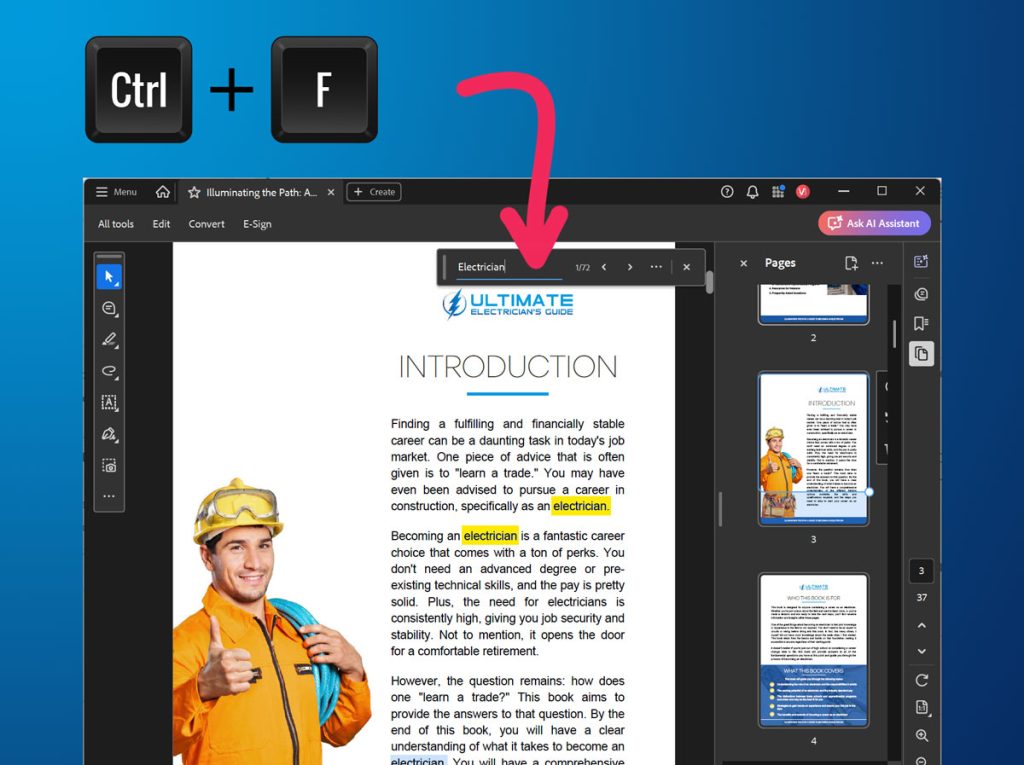
Search does. Ctrl+F works in the PDF, and it is fast if you know what to type.
But it is a genuinely different skill, and it is worth being honest about where it is weaker. An index is organized by concept. Search is organized by literal text. If you search for a word the code does not actually use, you get nothing, and if you search for a common one you get hundreds of hits to wade through. The index would have taken you to the right article in one step.
So the skill you need is knowing what word the code itself would use, which is a different thing from knowing the rule.
How to prepare for it
- Study from a digital NEC, not a paper one. Search behaves nothing like flipping and you need the repetitions.
- Learn article numbers rather than page positions. Position is meaningless on screen; the number is how you navigate.
- Practice searching by term. When you know a rule exists but not where, the word you type decides whether you find it in ten seconds or ninety.
- Build a feel for code vocabulary. The exam question and the code section often use different words for the same thing, and closing that gap is the whole skill.
- Get familiar with 70E and the Cal/OSHA guide as well, not just the NEC. They are provided for a reason and safety is 6% of the exam.
- Stop tabbing. If you have been building a physical book for this exam, that effort is better redirected.
The upside, and it is real, is that nobody else has their book either. The playing field is level, and the people who do well are the ones who practiced on the format rather than assuming it would be like every other state.
Take a 100% Free Practice Exam

Not sure where your knowledge gaps are? This free practice exam gives you a realistic feel for the real thing — so you can walk in on exam day knowing exactly where you stand.
Claim My Free Exam →Exam Day
- Arrive at least 30 minutes before your appointment. Late arrivals may not be admitted and the fee is forfeited.
- You need two forms of identification, not one. Both must be original and unexpired. One must be government-issued with your first name, last name, photo and signature. The second must show your name and signature, or your name and a recent photo.
- The names you registered with must match your identification exactly.
- No calculator. An on-screen calculator is provided.
- No notes, books, pens or pencils. No phones, smart watches, recording devices or AI glasses.
- No hats, scarves, gloves, umbrellas, wallets, purses, briefcases or backpacks. Car keys and your two IDs go in a locker.
- No breaks once the exam begins. You may use the restroom with proctor permission, signing in and out, and the clock keeps running.
- Sessions may be audio and video recorded.
The two-ID requirement is the one that catches people out, because most licensing exams ask for one. Turning up with a driver’s license alone means a voided registration, a forfeited fee, and reapplying with DLSE from the start.
Results, Certification and Retakes
You get your score at the test center as soon as you finish, and you can print copies from your online account afterwards. Seventy percent passes.
If you pass, your score report acts as proof of certification until the card arrives, which takes about two weeks by mail. CPS HR mails the card, so chase them rather than DIR if it does not turn up.
If you fail, California is unusually strict. You wait 60 days from the date you sat the exam before you can even send the retest application, and applications that arrive early are held until the 60 days are up. You pay another $100 and use the dedicated retest form.
That 60-day lockout changes the math on preparation. In Texas you can rebook a failed exam the same week. In California a failed attempt costs you two months plus another fee, and it eats into a one-year eligibility window that does not pause while you wait.
Fail to appear at all and you forfeit what you paid and reapply. Let the one-year eligibility lapse and you are back to the full $175 and a new application.
How Hard Is It?
DIR publishes statistical overviews of the electrical exams. The most recent covers 2023.
| General Electrician, 2023 | Result |
|---|---|
| Attempts in the year | 4,150 |
| First-time pass rate | 51.22% |
| Repeat pass rate | 39.75% |
About half pass first time, and the number gets worse on the second attempt rather than better, which tells you something about how people prepare between tries.
One caveat worth stating plainly, because it cuts in our favor and nobody else mentions it: that data is from 2023, when PSI ran the exam and the code book was paper. It predates both the change of vendor and the switch to a PDF. Nobody yet knows what the new format has done to the pass rate, and if you are testing now you are doing so without the one piece of information that would tell you how much harder it has become.
Keeping Your Certification
Certification renews every three years and requires 32 hours of continuing education from a California-approved provider before you renew. Your address and contact details need to stay current with DLSE.
How to Prepare
Weight your study the way the exam is weighted
Two thirds installation. That is not a suggestion, it is the published content outline. Wiring methods, sizing of every kind, grounding and bonding, and overcurrent protection deserve the bulk of your time
Train on the format, not just the material
This is the difference between preparing for the California exam and preparing for someone else’s. Everything above about searching, article numbers and code vocabulary applies from your first study session, not your last.
Practice the full length
Four and a half hours is a long sit. The clock is generous per question but the fatigue is real, and people lose points in the last hour that they would not lose in the first.
Four and a half hours is a long sit. The clock is generous per question but the fatigue is real, and people lose points in the last hour that they would not lose in the first.
Treat the first attempt as the only one
The 60-day wait means a fail is not a minor setback, and the repeat pass rate is lower than the first-time rate. Going in genuinely ready is worth more here than in almost any other state.
Frequently Asked Questions
Does California have a journeyman electrician license?
Not by that name. The equivalent credential is General Electrician certification, issued by the Department of Industrial Relations through the Electrician Certification Unit. If you hold a journeyman license from another state, you still go through California’s certification process.
How many hours do I need?
8,000 hours of electrical work for an electrical contractor, spanning at least two of nine defined categories, with each category capped. Industrial and commercial wiring cap at 6,000 hours each, residential at 3,000, and stock room and material handling at just 300.
Can I take the exam before I finish my hours?
Yes, by two routes. Apprentices in their final year can sit it with a DAS1 form, and electrician trainees who have completed an approved curriculum can sit it with their certificate. In both cases you can pass the exam, but no certification card is issued until the apprenticeship term or the required hours are complete.
How much does the California general electrician exam cost?
$175 for one exam, made up of a $75 application fee and $100 per examination. Two exams are $275 and three are $375. A retest is $100. None of it is refundable or transferable.
How many questions are on the exam?
100 questions, with 4 hours and 30 minutes to complete them. You need 70% to pass.
Is the California exam open book?
Yes, but you do not bring the book. Three references are provided on screen and you may not bring or use your own. That has always been the case in California; what changed in 2026 is that the references are now PDFs rather than paper copies.
Can I bring a tabbed NEC?
No. No reference material of any kind is permitted. This is the single biggest adjustment for candidates who trained elsewhere, and time spent tabbing a physical book for this exam is time wasted.
Does the PDF code book have an index?
Candidates report that it does not, which removes the lookup method most electricians rely on. Ctrl+F search does work, so the skill to practice is finding things by search term rather than through the index.
Can I bring my own calculator?
No. An on-screen calculator is provided. Personal calculators, notes, books, pens and pencils are all prohibited.
Which NEC edition does the exam use?
The 2023 edition, provided on screen.
What identification do I need?
Two forms, both original and unexpired. One must be government-issued showing your name, photo and signature. The second must show your name and signature, or your name and a recent photo. The names must match your registration exactly.
What is the pass rate?
DIR’s most recent published figures, from 2023, show a 51.22% first-time pass rate and 39.75% for repeat candidates. Those figures predate the switch to a PDF code book, so they may not reflect the current exam.
What happens if I fail?
You wait 60 days from your exam date before submitting a retest application, and pay another $100. Applications sent early are held until the 60 days have passed. Your one-year eligibility window keeps running during the wait.
How long is my eligibility good for?
One year from the date on your eligibility notice. If you have not passed by then, you reapply and pay the full fee again.
How do I renew?
Every three years, with 32 hours of continuing education from a California-approved provider completed beforehand.