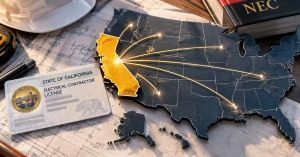
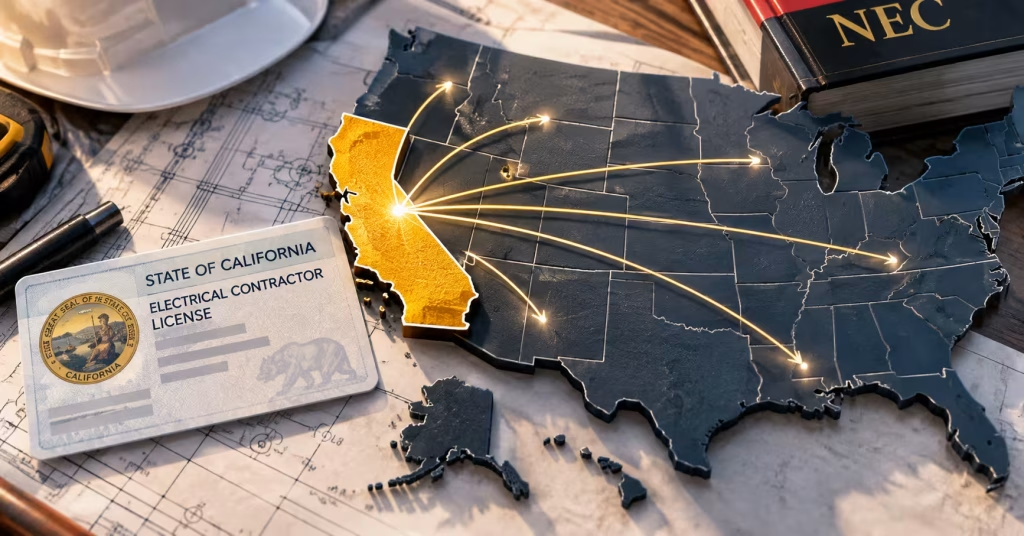
Search this question and you’ll get two answers. Some sites say California has no electrical reciprocity at all. Others say it reciprocates with Arizona, or Nevada, or three or four states depending on who you read.
They’re describing different credentials without saying so. California licenses electricians through two separate agencies, and the reciprocity answer is completely different for each.
Here’s the actual breakdown.
The Short Answer
What you hold | Reciprocity into California |
|---|---|
Journeyman or equivalent, individual license | None. You take the California exam. |
Arizona electrical contractor (C-11, K-11, L-11) | Yes, maps to the C-10 contractor license. |
Nevada low voltage (C-2d) | Yes, maps to the C-7 license. |
Nevada electrical sign (C-6, C-6b) | Yes, maps to the C-45 license. |
Contractor license from any other state | No electrical classification reciprocates. |
Two Agencies, Two Different Answers
This is the part that causes the confusion, and it’s worth getting straight before anything else.
DIR certifies electricians
The Department of Industrial Relations, through its Electrician Certification Unit, certifies you as an individual to do electrical work. General Electrician certification is the credential most people mean when they say journeyman, because California doesn’t use the word journeyman.
There’s no reciprocity here. None, from any state.
CSLB licenses contractors
The Contractors State License Board issues the C-10 Electrical contractor license. That’s the business credential, the one that lets you bid work, pull permits, and be the responsible party on a job.
CSLB does run a reciprocity program. It’s narrower than most articles suggest, but it’s real.
So when one site tells you California has no reciprocity and another lists four states, both are quoting something true about a credential they didn’t name.
If You’re an Individual Electrician
You’re taking the California exam. There’s no version of this where your out-of-state license substitutes for it.
Your license does still do something, though, and it’s worth more than people realize.
Your license counts as proof of experience
The hard part of qualifying for the California exam is documenting 8,000 hours of work across at least two of nine defined categories, each with its own cap. Industrial and commercial wiring max out at 6,000 hours each. Residential caps at 3,000. Stock room work caps at 300.
Someone who’s spent four years on residential service calls can hit 8,000 hours and still not qualify, because most of those hours fall outside what counts.
An electrician license from another state can serve as your proof of experience instead. No hour tables, no Social Security earnings records, no chasing former supervisors. You go straight to the application.
That isn’t reciprocity, since you’re still taking the exam. What it does is remove the worst part of the paperwork.
What the exam looks like
California General Electrician exam | |
|---|---|
Questions | 100 |
Time | 4 hours 30 minutes |
Passing score | 70% |
Code book | Provided on screen as a PDF. You cannot bring your own. |
Fee | $175, made up of $75 application and $100 exam |
The code book rule catches out almost everyone who trained elsewhere. California has never allowed you to bring your own NEC, and since 2026 the copy they provide is a PDF on the exam screen rather than a paper book on the desk. No other state does this, so the tabbing and highlighting habits you built somewhere else won’t help you here. Our guide to the California journeyman electrician exam covers that in depth, and the current candidate bulletin has the official rules.
Fail and you wait 60 days before you can even submit the retest application, plus another $100. That makes the first attempt worth taking seriously.
If You’re a Contractor
Now the reciprocity is real, and it’s narrow.
Arizona is the only state for C-10
CSLB publishes a Reciprocal Classifications List showing which out-of-state licenses map to which California ones. Three Arizona classifications map to California’s C-10 Electrical: C-11, K-11 and L-11, all of which Arizona calls Electrical.
No other state has an electrical classification on that list. Not Nevada, not Louisiana, not North Carolina, not Mississippi. Their reciprocal classifications are general building and a handful of other trades.
So if you hold an electrical contractor license outside Arizona, C-10 reciprocity isn’t available to you, whatever a general article about California contractor reciprocity might suggest.
Two other doors, both Nevada
Worth knowing if your work sits in these areas:
Nevada license | California equivalent | What it covers |
|---|---|---|
C-2d | C-7 | Low Voltage Systems |
C-6, C-6b | C-45 | Electrical Sign |
These are separate classifications with narrower scopes than C-10, so they won’t cover general electrical contracting. For low voltage or sign work specifically, they’re a genuine route in.
What contractor reciprocity requires
- The classification you want appears on the Reciprocal Classifications List.
- You’ve held an active license in good standing in the reciprocal state for the previous five years.
- Your licensing agency completes a Request for Verification of License and sends it to CSLB.
- You complete the Application for Original Contractor’s License.
Five years is a longer bar than most states set, and it’s the condition that disqualifies the most people. CSLB sets out the full reciprocity requirements on its own site.
Two things reciprocity doesn’t get you
The Law and Business exam is still required. Reciprocity can waive the trade portion, and it never waives the business portion.
And the waiver isn’t automatic. CSLB’s own wording is that it may waive the trade exam but retains the right to require it. Qualifying on paper doesn’t guarantee the waiver, so plan on the possibility of testing anyway.
Why the Published Lists Disagree
If you’ve read three articles and seen three different lists of states, there’s a reason, and it isn’t entirely the fault of the people writing them.
CSLB’s own website gives different answers on different pages. One page names Arizona, Louisiana and Nevada. Another adds North Carolina. Two more add Mississippi. All four are live at the same time.
The Reciprocal Classifications List is the page that actually matters, because it’s the one that says which classifications transfer rather than just which states have agreements. A state can be on the agreement list and have no electrical classification on it at all, which is exactly the situation with Nevada, Louisiana, North Carolina and Mississippi.
That distinction is why a general article about California contractor reciprocity can be technically accurate and still leave an electrician with completely the wrong impression.
If You’re Coming from Somewhere Else
Most electricians moving to California are in this position, so here’s the practical route.
- Work out which credential you actually need. If you’re working for a licensed contractor, that’s General Electrician certification from DIR. If you’re running the business, that’s a C-10 from CSLB.
- For certification, apply to DLSE using your out-of-state license as proof of experience. That skips the hour documentation.
- Study for the exam on a digital NEC rather than a paper one, because that’s what you’ll have in the room.
- For a C-10, check the Reciprocal Classifications List first. If you’re not coming from Arizona, plan on the full application and exam.
- Call before you pay anything. CSLB’s Licensing Information Center is on 1-800-321-CSLB, and DIR’s Electrician Certification Unit handles certification questions.
Heading somewhere else instead? We cover Texas reciprocity and Colorado reciprocity separately, along with how transferring an electrical license works generally.
Frequently Asked Questions
Does California have electrical license reciprocity?
It depends which credential. There’s no reciprocity for General Electrician certification, which is the individual electrician credential from DIR. For the C-10 electrical contractor license from CSLB, there’s reciprocity with Arizona only.
Can I use my out-of-state journeyman license in California?
Not to work. California requires its own certification and you’ll take the exam. Your out-of-state license can serve as proof of experience to qualify you to sit it, which removes the hardest part of the application.
Which states have contractor reciprocity with California?
CSLB has agreements with Arizona, Louisiana, Nevada, North Carolina and Mississippi, but the agreements only cover classifications on the Reciprocal Classifications List. For electrical work specifically, only Arizona has classifications that map to California’s C-10.
Does Nevada reciprocate with California for electricians?
Not for general electrical contracting. Nevada’s low voltage license maps to California’s C-7, and its electrical sign licenses map to C-45, but there’s no Nevada classification that maps to C-10.
How long do I need to have held my license?
For CSLB contractor reciprocity, five years active and in good standing. That’s longer than most states require.
Will I still have to take an exam?
For certification, yes, always. For contractor reciprocity, the trade exam can be waived but the Law and Business exam is always required, and CSLB reserves the right to require the trade exam anyway.
Can I bring my own code book to the California exam?
No. California provides the references on screen and doesn’t permit you to bring your own. That has always been the case here, and since 2026 the provided copy is a PDF rather than paper.
What does the California exam cost?
$175 for one exam, made up of a $75 application fee and $100 per examination. A retest is $100 and you wait 60 days before you can submit the application.
Do I need a C-10 to work as an electrician in California?
No. You need General Electrician certification to do the work for a licensed contractor. The C-10 is what you need to be the contractor, bid work and pull permits.